- UKG
- Class 1
- Class 2
- Class 3
Cursive writing A to Z, on the four lines your child uses at school
Printable A4 worksheets on the same four-line ruling Indian schools use.
Line 1 to line 3, the way the teacher marks it.
Cursive Writing A to Z is an Indian school handwriting system that teaches capital letters, small letters, and joining on four-line copy, for kids in UKG to Class 3.
Why the four-line ruling matters
When a teacher writes "size not proper" on a copy, she is marking height and placement, not shape. Line 1 is the ceiling for capitals, lines 2 and 3 hold the body of every small letter, and line 4 catches the tails of g, j, p, q and y.
Ten minutes on the right ruling fixes a remark that an hour on a blank page cannot.
How the practice page works
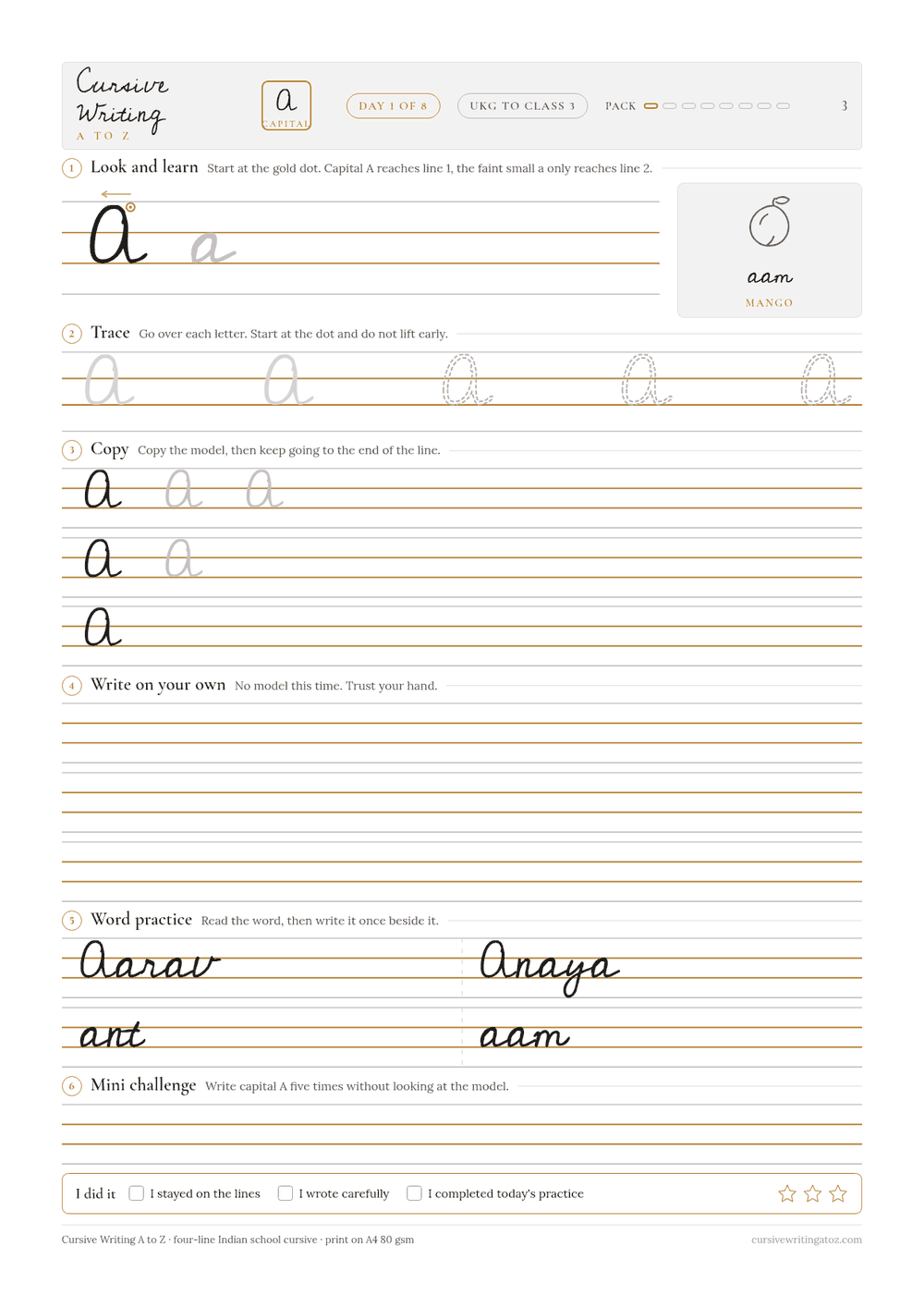
- 1 Look The model letter, at the top of the page on the four lines.
- 2 Trace Dotted rows to trace over.
- 3 Copy Empty rows to copy the model.
- 4 Write Blank rows to write from memory.
- 5 Word One word that uses the letter.
See the actual pages
Four of the 55 pages in the file, exactly as they print. Nothing here is drawn for the website.
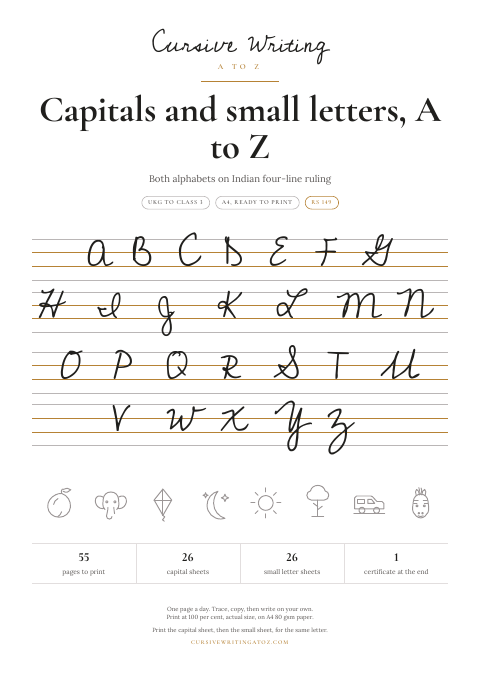
Cover 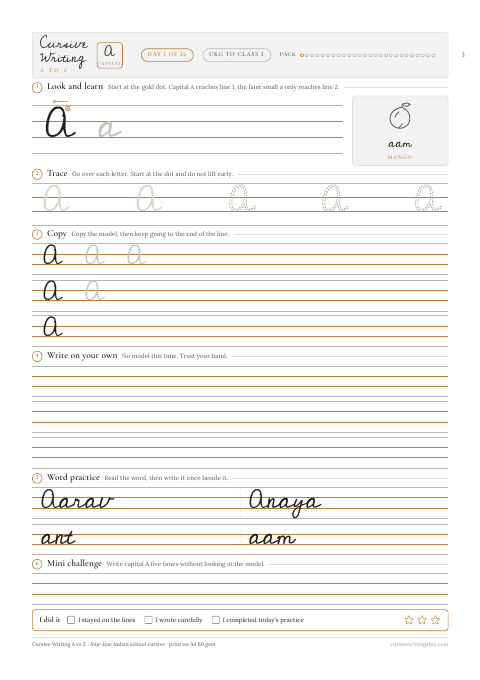
Page 3, capital A 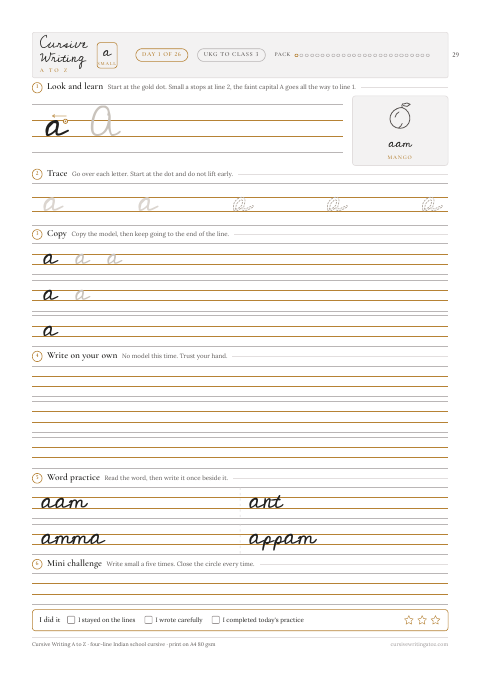
Page 29, small a 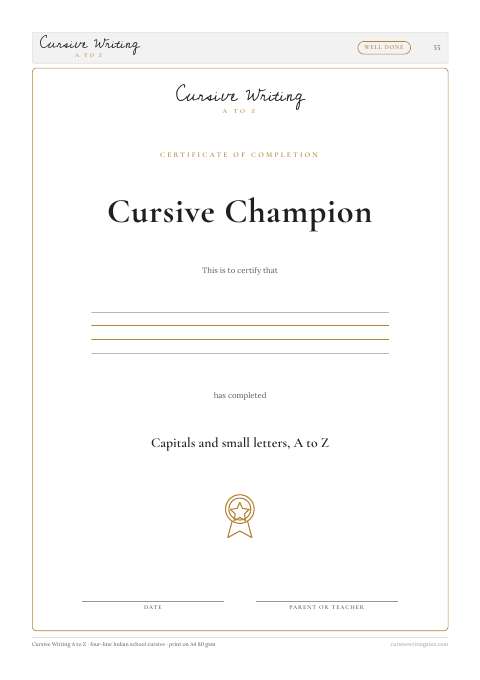
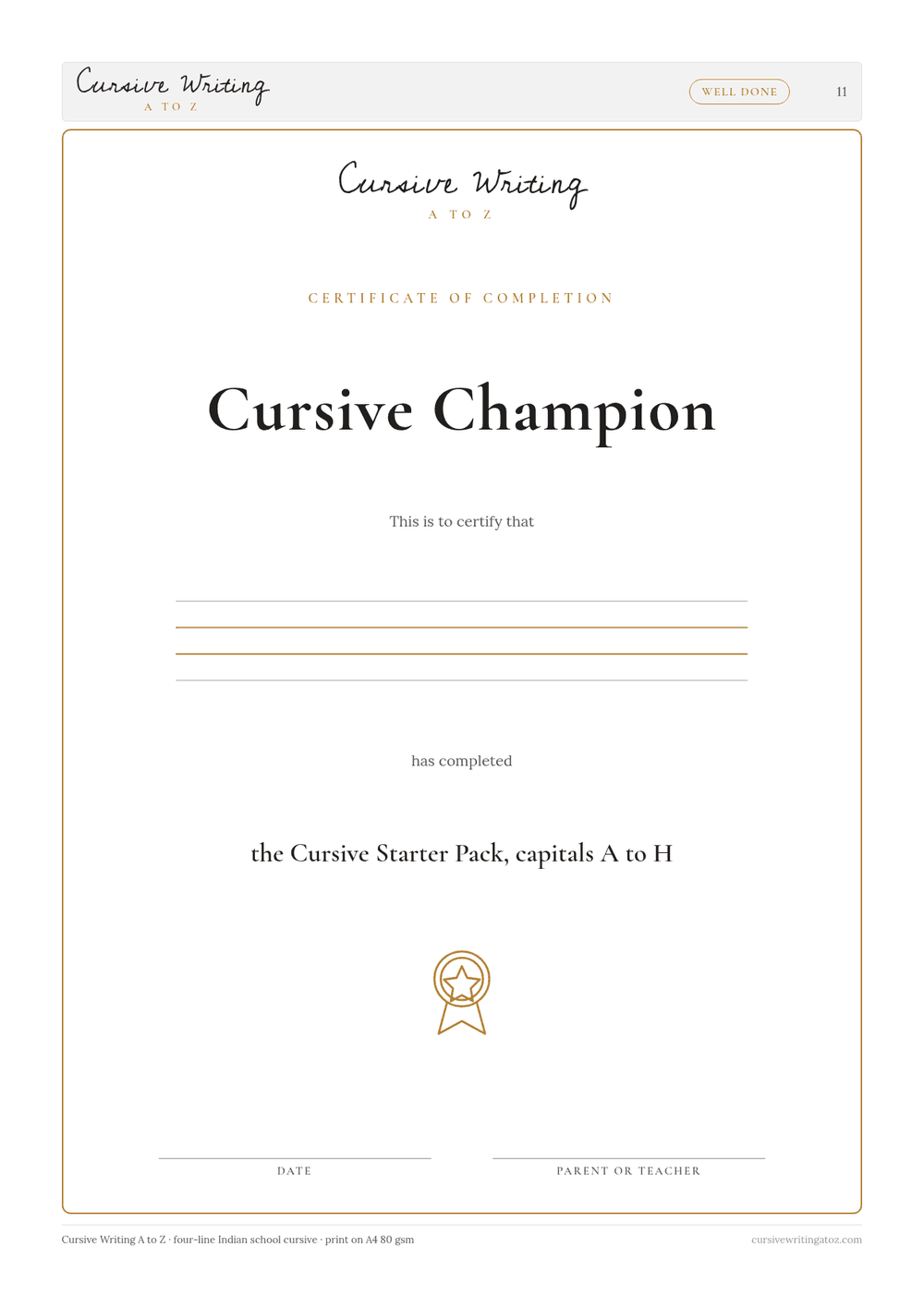
Page 55, certificate
Print on A4 at actual size. Black and white is fine.
What you get
26
Capital letters
26
Small letters
55
Pages
A4 PDF
Print at home or xerox shop
Choose what fits your child
Start here
A to Z cursive
Capital + small letters, guided practice
Best first buy for UKG and Class 1
Rs 149
Get the A to Z bookDaily practice
30-day challenge
One dated practice page per day for a month
Rs 199
Get the 30-day challengeMost complete
All seven packs
A to Z pair, 30-day challenge, joining words, sight words, Indian names, cricket cursive, Indian festivals
Rs 1,073 bought separately
Rs 399
Save Rs 674
Get the complete bundle
Try it free first
Eleven A4 pages, capitals A to H, by email. No payment needed.
Who this is for
UKG
Capitals first: the ceiling line and the shape.
Class 1
Capitals settled, moving to small letters and their heights.
Class 2
Small letters consistent, beginning to join them.
Class 3
Joining letters into words, building speed.
Teachers
Classroom sheets on the same ruling as the school notebook.
Browse by letter
Each letter has its own page: capital, small letter and example words.
Made for the Indian school notebook
Generic three-line sheets put the body of the letter in the wrong place. These pages use four-line Indian ruling: grey outer lines, gold inner pair. Capitals, small letters, and the words at the bottom of each sheet sit on the same lines the teacher marks.
Four heights, one ruling
The sheet shows where each kind of letter lives. You can point. They can see it.
More than tracing the same letter fifty times
- LookA large letter on the four lines.
- TraceLight letters to go over.
- CopyA model at the start of the row.
- WriteEmpty four-line rows.
- WordAarav, Diya, tiffin, dosa.
How delivery works
Pay on PayU by UPI, card or netbanking. The PDF arrives by email as soon as you pay. Print on A4 at actual size, not fit to page. The file does not expire.
Before you pay
A file, a rupee price and an email address. Here is who is on the other end of it.
- Payment on PayUUPI, card or netbanking on PayU's own page. No card number is typed on this site, and we never see one.
- The file comes by emailThe PDF is attached to an email that goes out as soon as PayU confirms the payment. No account to make and no link to expire. If it does not arrive, the same mailbox reaches a person.
- It prints at the xerox shopPlain A4, black and white, no colour ink and no special paper. Print at 100 per cent actual size, because fit to page shrinks the ruling and then it stops matching the school notebook.
Sold by DigiNhance DBA CursiveWriting, 204 Mangalmurti CHS, Plot C-21, Sector 9, Airoli, Navi Mumbai 400708. One mailbox, hello@cursivewritingatoz.com, read by a person. Ask before you order if you are not sure which book fits.
Questions parents ask
What age or class is this for?
UKG to Class 3. Pick by the hand in front of you, not the label on the year: capitals first, then small letters, then joining.
Is it a physical book?
No. It is an A4 PDF, emailed after payment. Print it at home or at a xerox shop, black and white is fine.
What do I receive?
26 capital letter sheets, 26 small letter sheets and a certificate page, each on the four-line ruling.
How is it delivered?
The PDF is emailed as soon as you pay. It is not an automatic download.
Can I print it again?
Yes. The file does not expire and there is no reprint charge. If you lose it, write to hello@cursivewritingatoz.com and it will be sent again.
What paper size do I need?
A4. Print at 100 per cent, not fit to page, or the ruling shrinks and no longer matches the school copy.
Can teachers use it?
Yes. One purchase covers classroom printing, and the ruling already matches the school notebook.
What if I do not receive the email?
Check promotions and spam first. If it is still not there, write to hello@cursivewritingatoz.com with your PayU transaction id and it will be sent again.
Is this a replacement for school practice?
No. It is home practice on the same ruling the school uses, so table work matches what the teacher marks.
Ready to start practising?
A to Z Cursive Writing · 55 pages · Rs 149
Get the A to Z bookWhat a sheet actually looks like
Printed A4, black and white, ordinary 80 gsm paper. This is the page, not a picture of a page.
Page updated 2026-09-15.